

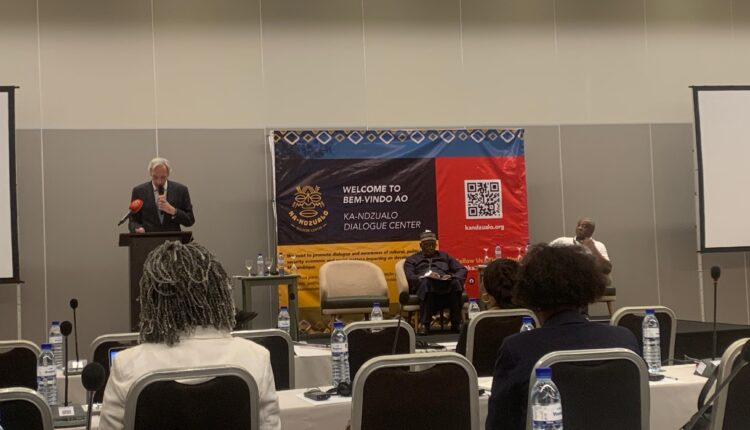

Philosopher denounces intellectual vacuum and global submission, warning: without independent thinking, Africa risks a new form of colonialism
The intervention of Severino Ngoenha at the “Civil Architecture of Peace” event, organized by the Centro de Diálogo Ka-Ndzualo, was not an academic exercise nor a ceremonial speech. It was a frontal attack — on how Mozambique thinks, or avoids thinking, about its place in the world.
More than criticism, Ngoenha exposed a structural problem: the country operates without its own strategic thinking. At a time when the international order is being reshaped by major powers, Mozambique — and, by extension, Africa — remains in near-total silence. And in this context, silence is not neutrality; it is irrelevance.
The philosopher’s central provocation is simple and unsettling: how can a country engage in global dialogue if it has no ideas of its own? For Ngoenha, the concept of dialogue has been emptied in the Mozambican context. What exists is not an exchange of visions, but the uncritical reproduction of external narratives. Terms such as multilateralism, human rights, or international order are invoked as if they were universal constructs, when in fact they are historical products of power relations from which Africa was excluded.
The critique goes further. According to the philosopher, Mozambique has adhered to an international architecture it did not help build — one that continues to reproduce its subordination. Formal participation in global institutions does not translate into real power. Often, it means legitimizing rules set by others.
In this sense, the current crisis of multilateralism should not automatically be mourned. On the contrary, it could be seen as an opportunity for repositioning. But that would require something Ngoenha sees as lacking: internal capacity for strategic reflection.
The diagnosis becomes harsher when turned inward. In a country rich in resources yet marked by structural poverty, the philosopher questions national priorities. While much of the population struggles with basic needs — food, education, healthcare — public debate remains trapped in political conflicts, internal rivalries, and fragmented agendas. The implicit question is devastating: does Mozambique want to be a collective project, or merely a space of permanent dispute?
At the regional level, the analysis dismantles another illusion: integration within the Comunidade de Desenvolvimento da África Austral (SADC). For Ngoenha, the bloc has abandoned its political foundation of solidarity and turned into an asymmetrical market, where stronger economies — particularly South Africa — dictate the pace. The result is a form of integration that weakens the vulnerable instead of strengthening them.
The continental critique follows the same logic. The União Africana is portrayed as a structure unable to assert an autonomous agenda, often dependent on external validation. Pan-Africanism, once a project of emancipation, now appears stripped of real political substance.
But it is in his reading of the global landscape that the speech reaches its most provocative edge. Ngoenha suggests that the world is returning — openly — to a logic of domination. Major powers no longer conceal their intentions to impose interests, redefine rules, and compete for strategic territories — including in Africa. In such a context, fragile and disjointed states inevitably become arenas of confrontation.
The implication is clear and unsettling: if nothing changes, Africa risks not just repeating history, but reliving it in new forms. Colonialism may no longer carry the same name, but its mechanisms — control, dependency, imposition — remain very much alive.
Perhaps the most uncomfortable point in his intervention is this: the greatest risk does not come from outside, but from within. Internal fragmentation, lack of shared vision, and inability to define national priorities create the perfect conditions for external subordination.
Ngoenha does not offer easy solutions, but he outlines a demanding path: rebuild thought, redefine language, create spaces for autonomous reflection, and above all, assume responsibility for building a coherent national and regional project. Without that, any discourse on sovereignty will remain rhetorical.
In the end, the message is neither diplomatic nor conciliatory. It is a warning: in a world driven by power struggles, those who do not think for themselves do not choose their destiny — they are chosen.
